For those of us who have been calling for systemic change in how Indian schools approach student mental health, April 2025 felt like a turning point. CBSE issued two notifications — TRG-3/2025 and TRG-2/2025 — that established, for the first time, a mandatory Continuous Professional Development framework requiring every teacher in every CBSE-affiliated school to complete 50 hours of training annually, aligned with the National Professional Standards for Teachers and the vision of NEP 2020.
Then came the Supreme Court order in July 2025 — directives on certified mental health training, crisis intervention protocols, parent sensitization, anonymized wellness reporting, and referral pathways.
And then, just days ago — on February 20, 2026 — CBSE issued Circular TRG-03/2026, its most direct and far-reaching directive yet. Titled “Promoting Mental Health and Wellness and Social Emotional Learning in Schools,” it explicitly references the Supreme Court judgment and lays out five non-negotiable requirements: mandatory mental health training for all teaching and non-teaching staff at least twice a year by certified professionals, regular parent and guardian sensitization programs, anonymized annual wellness reporting, prioritization of co-curricular activities over exam-only identity, and structured career counselling to reduce academic pressure.
This is no longer a recommendation. It’s a directive from the Board to every affiliated school in India.
I have been working in this space long enough to know that mandates alone don’t save lives. But mandates do something critical: they shift the conversation from “should we?” to “how do we?”
That shift matters enormously. And schools need to be ready for it.
What’s Actually Being Asked of Schools
Let me cut through the circular language and lay out what the combined effect of these directives actually requires.
CBSE’s 50-hour annual CPD framework breaks into three domains under the NPST: Core Values and Ethics (12 hours), Knowledge and Practice (24 hours), and Professional Growth and Development (14 hours). Of the total, 25 hours must come through CBSE or Government Regional Training Institutes, and the other 25 through in-house or School Complex-based programs.
The Supreme Court’s order adds a layer of specificity that goes well beyond general professional development, and TRG-03/2026 codifies it into actionable requirements. Schools must now ensure that all teaching, non-teaching, and administrative staff undergo mandatory training at least twice a year — conducted by certified mental health professionals — covering psychological first aid, identification of warning signs, response to self-harm, and referral mechanisms. Schools must regularly organize sensitization programs for parents and guardians, specifically addressing undue academic pressure and recognition of psychological distress. They must maintain anonymized annual reports documenting wellness interventions, student referrals, and training sessions. They must prioritize co-curricular activities and periodically review examination patterns to cultivate identity beyond test scores. And they must provide structured career counselling that is inclusive, sensitive to social and economic context, and doesn’t reinforce narrow definitions of success.
Read together, these aren’t suggestions. They’re a compliance framework. And most schools — even well-resourced ones — don’t have the infrastructure to deliver on all of them simultaneously.
The Real Challenge Isn’t Awareness. It’s Architecture.
I wrote earlier about why the adults closest to our students hold the key to protecting them — why the proximity and trust that teachers already have makes them the most natural first responders for a child in distress. (Read that piece here.)
That argument hasn’t changed. What’s changed is the regulatory environment around it.
The challenge facing principals today isn’t convincing anyone that student mental health matters. That conversation is largely settled. The challenge is architectural: How do I build a system within my school — with the staff I already have, the budget I’m working with, and the academic calendar I can’t abandon — that meets these requirements and actually works?
This is not a problem you solve by hiring one more counselor. It’s not a problem you solve by sending two teachers to a weekend workshop. It requires a structured, institution-wide framework that builds capacity across the entire school, not just in isolated pockets.
Why We Built SWISS the Way We Did
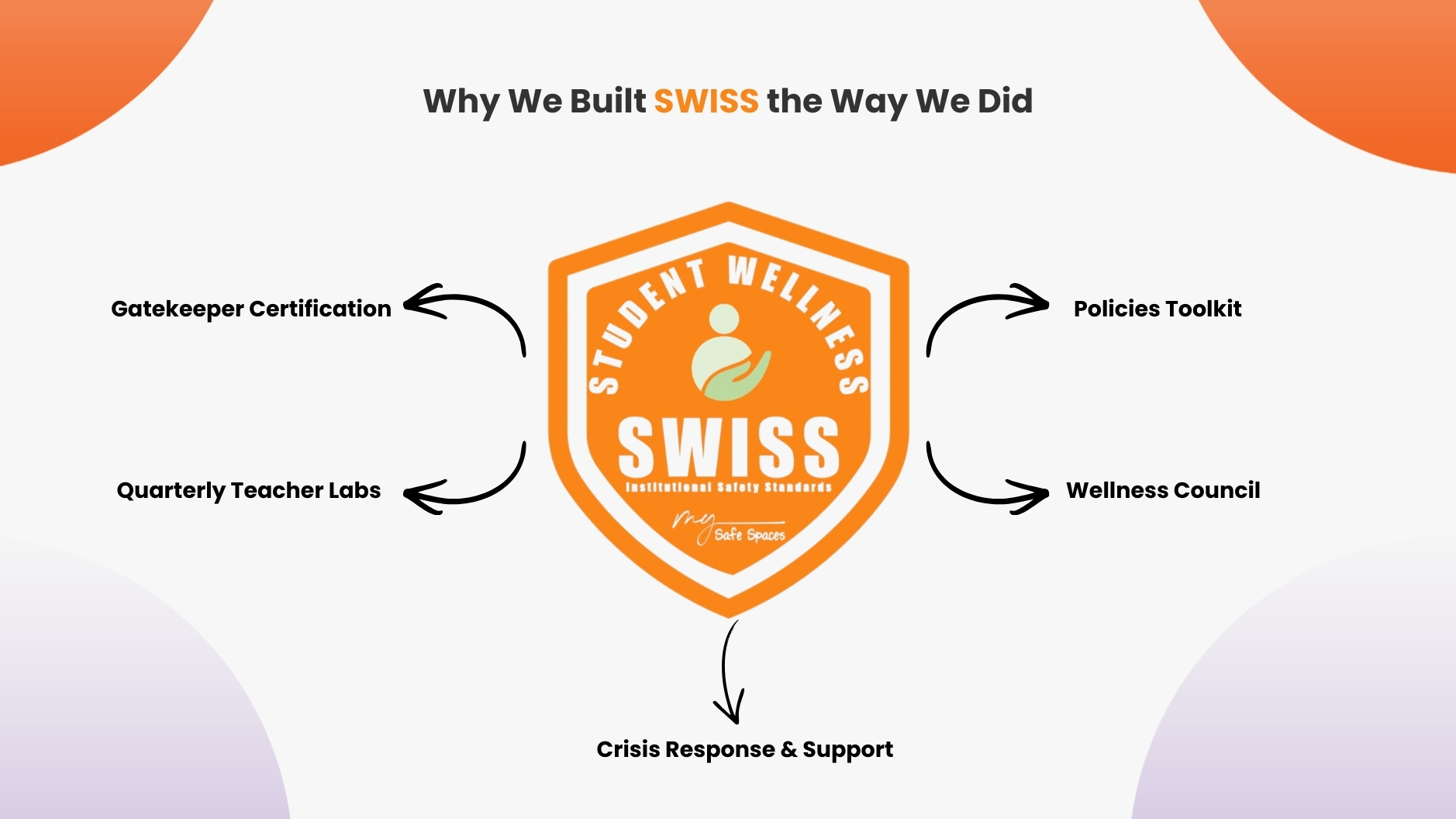 SWISS — Student Wellness & Institutional Safety Standards — was designed long before these mandates arrived. We built it because the evidence was clear: gatekeeper training works, institutional standards create accountability, and piecemeal approaches don’t hold. But the fact that CBSE and the Supreme Court have now codified so much of what SWISS already delivers is, I’ll admit, deeply validating.
The five pillars were designed to cover exactly what’s now being mandated: Gatekeeper Certification (4-hour, self-paced, CPD UK-accredited), trains every teacher to recognize warning signs and respond. Quarterly Teacher Labs (2 hours × 4) reinforce that training throughout the year. Together, that’s 12+ certified CPD hours — counting directly toward CBSE’s 25-hour in-house requirement. The Policies Toolkit provides ready-to-adopt wellbeing, grievance, and anti-bullying documents with built-in audit infrastructure. The Wellness Council establishes a trained 5-member team with parent engagement protocols and annual simulation exercises. And Crisis Response & Support provides 24/7 rapid deployment — on-site therapists, virtual follow-up, post-recovery review — when a school needs it most.
But here’s what I believe sets SWISS apart from anything else available today: we understand that student wellness is a shared responsibility — between parents, teachers, and school systems. The CBSE mandate charts a path for school systems and teachers, and rightly so. But a child’s world doesn’t end at the school gate. SWISS fully embraces this shared responsibility by providing optional complementary education and training made available to parents — equipping them to recognize the same warning signs, speak the same language of care, and reinforce at home what’s being built at school. We are the only program that straddles across all of these divides — schools, teachers, parents, and students — to provide a comprehensive wellness and safety system that can truly protect children and give them the opportunity to thrive.
Across all 8 mandates from the Supreme Court and CBSE, SWISS addresses every one — 6 exceeded, 2 met or exceeded. That’s not a coincidence. It’s because the research that informed our design and the evidence base that informed the government’s directives come from the same place: what actually works.
When Associations Lead, Schools Follow
I want to highlight something that gives me genuine hope.
TAISI — The Association of International Schools of India — has recognized the importance of this moment and partnered with My Safe Spaces to deliver SWISS certification to its 300+ Tier 1 member schools.
That is leadership by example. That is leadership where it counts.
When one of the most respected school associations in India moves proactively — not in response to a crisis at one of its schools, not after a headline, but because the evidence and the mandate both point in the same direction — it sends a powerful signal. It tells every other school network, every trust, every board: this is the new baseline.
I have spoken with principals across the country who tell me they want to act but feel paralyzed by the logistics. TAISI’s decision demonstrates that it’s possible to move decisively and at scale. I hope others follow.
A Word to the Principals Still Deciding
I understand the weight of what’s being asked of you. You’re managing academic standards, board expectations, parental pressure, staff wellbeing, and now a compliance framework that touches every one of those areas at once. Adding “mental health certification” to the list can feel like one more demand on a system already stretched thin.
But here’s what I’d ask you to consider: this isn’t a new burden being placed on your school. It’s a formal acknowledgment of a responsibility your school has always carried — the safety and wellbeing of the children in your care. CBSE and the Supreme Court haven’t created a new obligation. They’ve named an existing one and attached accountability to it.
SWISS was designed with that reality in mind. The Gatekeeper course is self-paced — teachers complete it on their own time, not away from classrooms. The Labs are two hours per quarter. The Policies Toolkit provides finished documents, not blank templates. The annual cost is predictable, with everything included: training, labs, policies, wellness council setup, crisis response, the SWISS certification seal, and an annual compliance audit.
The regulatory direction is set. The question for school leaders isn’t whether to invest in student mental health — that question was answered by CBSE, by the Supreme Court, and frankly, by the families who trust you with their children every morning.
The question is whether you want to be among the schools that led, or among those that followed.
I hope you’ll choose to lead.
Hubert Jerome is the Founder & CEO of My Safe Spaces. SWISS Certification is accredited by the CPD Standards Office UK (Provider #50828) and backed by research from Mindful Dignity Lab.
📧 swiss@mysafespaces.org
🌐 mysafespaces.org/swiss
“The future depends on what you do today.” — Mahatma Gandhi